 Update July 15th, 2025
Camera Interfaces and Frame Grabber Support:
At FIBUS, we have been following the development of new camera/PC-interfaces closely over the last 9 years since our last news letter. Definitely a lot has happened, but camera/PC-interfaces have not become simpler or easier. CoaxPress has now more or less established as a standard, but iin our opinion this standard has many disadvantages: the connectors have been changes several times and are therefore not compatible (BNC, 5W5, Mini-DIN, Mini-BNC). Cable lengths are still to short for real applications. And glas fiber extenders are available but complex and expensive.There are several systems with CameraLink HS interface, but our tests have shown that all this is not really compatible. We have tested cameras from one manufacturer on CameraLink HS frame grabbers of another manufacturer and could not get it running, not even with extensive help of the manufacturers. So we would be at least very careful to recoomend this interface...
The GigE interface has grown during the last years and when finally the 10GigE, 25GigE, and even the 100GigE-interface showed up, we could implement several real-high-speed systems with this interface and with cameras from Emergent Imaging. Especially at 100GigE with two cameras in one computer, with some additional memory copying and some image analysis, we definitely reached the memory bandwidth limit of the fastest computer systems at some 100GByte/s. The GigE interface does have some limitations, too: when using regular network NIC cards instead of frame grabbers, which do not have a lot of intermediate memory and cannot buffer images, it might happen that images get lost if we get closer to the maximum interface bandwidth. Additionally, it seems not possible to send exact trigger pulses via the GigE interface. When two or more cameras have to be synchronized, we would either have to synchronized these cameras externally by special trigger signals, or we would have to rely on not so exact timing control systems, like IEEE 1588/PTP Precision Time Protocol (PTP). In contrast to regular frame grabbers, these types of protocols cannot guarantee NanoSecond exact trigger synchronization. On the other hand the cable length with glass fiber can be extended to several hundred meters with multi-mode glass fibers and even to several kilometers with single mode fibers. Using this interface with the HZ-21000 camera from Emergent, it is possible to acquire stereo images from two cameras with 21 Megapixel resolution and at 540fps at 8 bit gray levels!
An additional very interesting new interface is the external PCIe interface, as being used by XIMEA. We implemented this interface, but we do not have too much experience with it so far...
The KAYA API is now supported, which is available with its Komodo frame grabbers for 10GigE, CoaxPress, CameraLink HS, or proprietary KAYA interface.
And finally, the camera interface for Matrix Vision GigE cameras has been implemented.
The GeniCam interface has now been established and should make camera control much easier. For all frame grabbers or cameras that support GeniCam, it is implemented in the picCOLOR program. With this feature, the complete camera setting can be defined for instance in the startup Macro STARTUP.MCR
Available special modules:
- 3D/Sequence processing- Interferometry
- Stereometric measurement and display
- Particle Image Velocimetry / Particle tracking (PIV/PTV), also as Library or DLL
- ((New)) Volume Particle Image Velocimetry - 3D PIV
- Time-Resolved PIV - Real-Time PIV
- 2D/3D-Position-Tracking in Real Time
- Multi-Camera Tracking
- Real Time Processing
- Fringe Correlation Method (for surface deflection measurement)
- True Color Extensions
- OCR/OCV Character recognition and rotation
- Bar Code Reader 1D/2D
- Neuronal Network Processing
- Graph Theory
- User-Programming in "C"
- ((New)) OpenCV Extendion Module
- ((New)) OpenGL Extension Module (including a flight simulator)
- ((New)) 4D Graphics Extension Module
- ((New)) 16 Bit Gray Level Operation Extension Module, useful for cameras with more than 8 bit gray levels
Some of the new functions implemented in the past years are:
New functions in the picCOLOR basic program:
- Macro programs can now be encrypted - now it is possible to distribute Macro programs without disclosing the code- A new parser with operator precedence for Macro programs was implemented, with lots of operators
- The B16 image format of PCO company is supported for load and save
- A log file can be used which logs all picCOLOR starts and stops and all disk accesses
- EXIF and GPS data is not read from TIF images
- PNG image format implemented for image load/save, including alpha channel for transparency
- Load/Save TIF images with tiles was implemented
- Load/Save TIF images with LZW compression was implemented
- TWAIN interface was fully implemented
- WIA interface was fully implemented because TWAIN is not supported anymore by scanner manufacturers for 64 bit systems
- new binarization methods (Sauvola and others)
- Macro calls can now be implemented in the user menu for easier access
-
- Many other mayor or minor improvements of the basic functions are implemented
3D/Sequence extension module:
- Stream saving is now enabled for up to 1001 1GByte big files, which is up to 1 Terabyte- Lots of new 3D graphics functions have been implemented
- Volume history
- 3D rotations in 3D image buffer
- Rank 3D function was implemented
- Voronoi 3D function was implemented
- Triangulation 3D function was implemented. It allows to triangulate real 3D graphics, either Voronoi or Pixel based.
- Render 3D. This function can display triangulated 3D-graphics.
- Load 3DS files (3DS is a well known 3D graphics format)
- Convert 3DS data into picCOLOR O3L format and save/load/edit O3L format
- 3D FFT and inverse FFT
- 3D maximum finder
2D/3D Real Time Object Tracking Extension Module:
- Introduced SVD method for 3D tracking of object position with angles and displacement- Kurillo 3D-calibration (using a magic wand)
- Implementation of parts of the well known "camera calibration toolbox"
- Many other minor improvements of the Real Time Tracking module are implemented
Particle Image Velocimetry extension module:
- No news here, but see the 3D-Volume PIV Extension Module below!((New)) Volume Particle Image Velocimetry - 3D PIV
- Complete set of functions for 3D particle image velocimetry, not yet multithreaded so far...- Draw 3D-PIV velocity results as 3D vector field. Display with CPU renderer or with OpenGL renderer
- Optimizations will be implemented as soon as this new extension module will find some usage...
((New)) OpenCV Extendion Module
- The OpenCV imaging software was adapted to picCOLOR. Many low level functions have been ported already,- and additional functions can be implemented on requent
((New)) 4D Graphics Extension Module
- Define/Free 4D image buffers- Simple graphics in 4D image buffer (lines, hyper-cuboids, hyper-spheres, hyper-ellopsoids, etc)
- Conversion of 4D wire frame graphics into 4D vector graphics and 4D display projection to 3D-image buffer or to 2D-image
((New)) 16 Bit Gray Level Operation Extension Module, useful for cameras with more than 8 bit gray levels
- Many cameras are capable of acquiring more than 8 bit gray levels. With this extension of the picCOLOR program, up to 16 bits of gray levels can be acquired and saved and analysed. Available image file formats for 16 bits are TIF or B16((New)) OpenGL Extension Module (including a flight simulator)
- Render 3D objects with OpenGL renderer- Flight simulator with scenes taken from 3DS object files or from picCOLOR 3D-objects
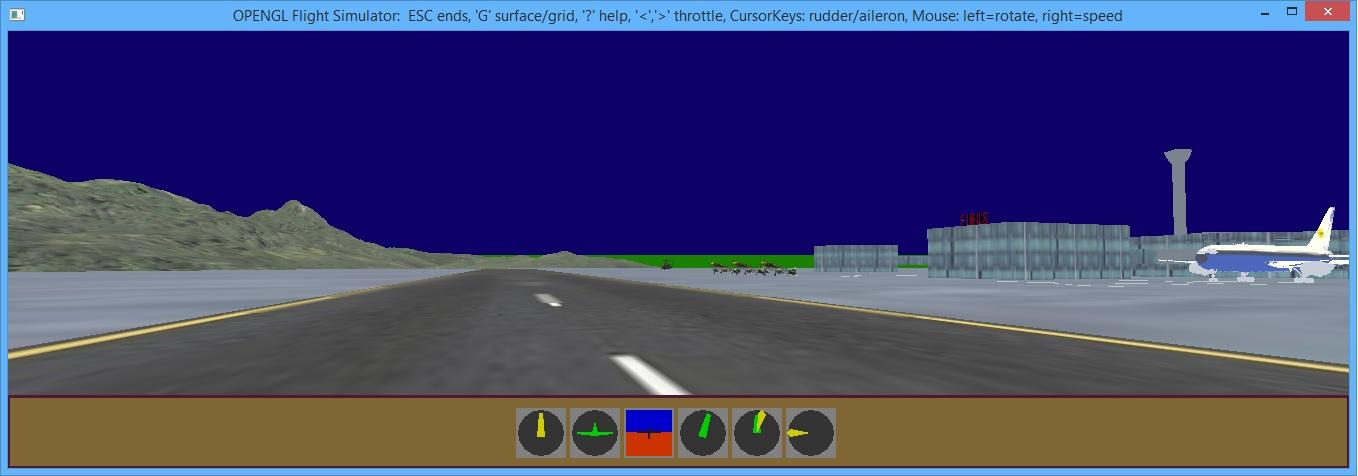
The FIBUS Airport
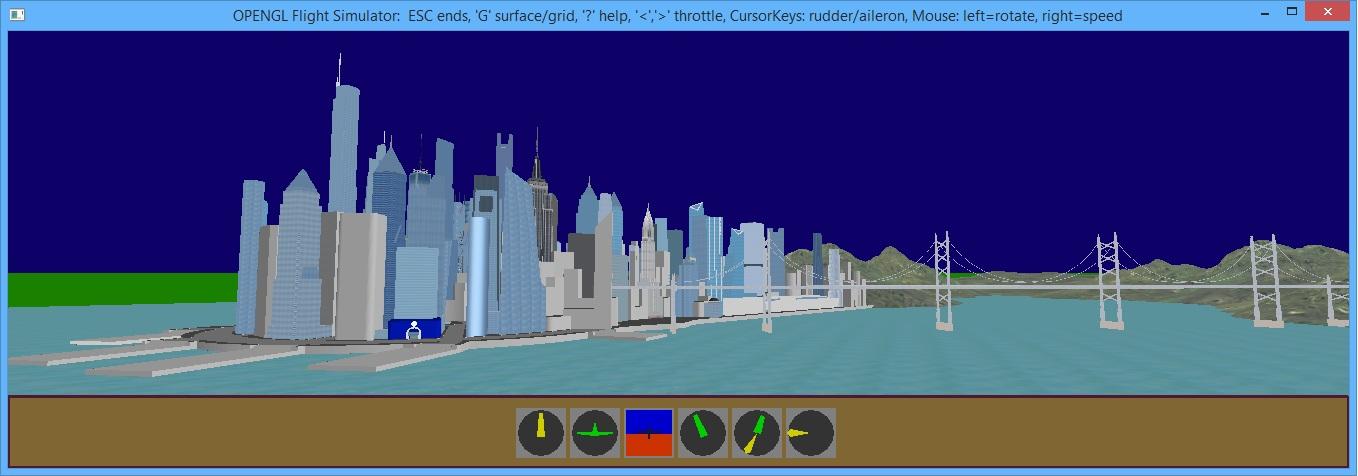
New York City
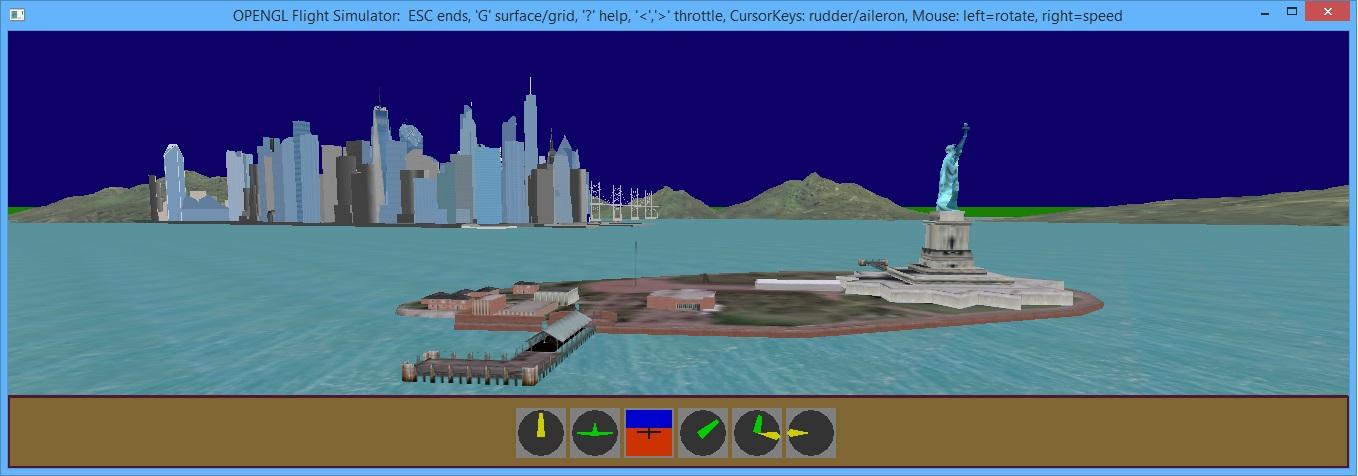
Liberty Island


Back to FIBUS Home Page